
The Book
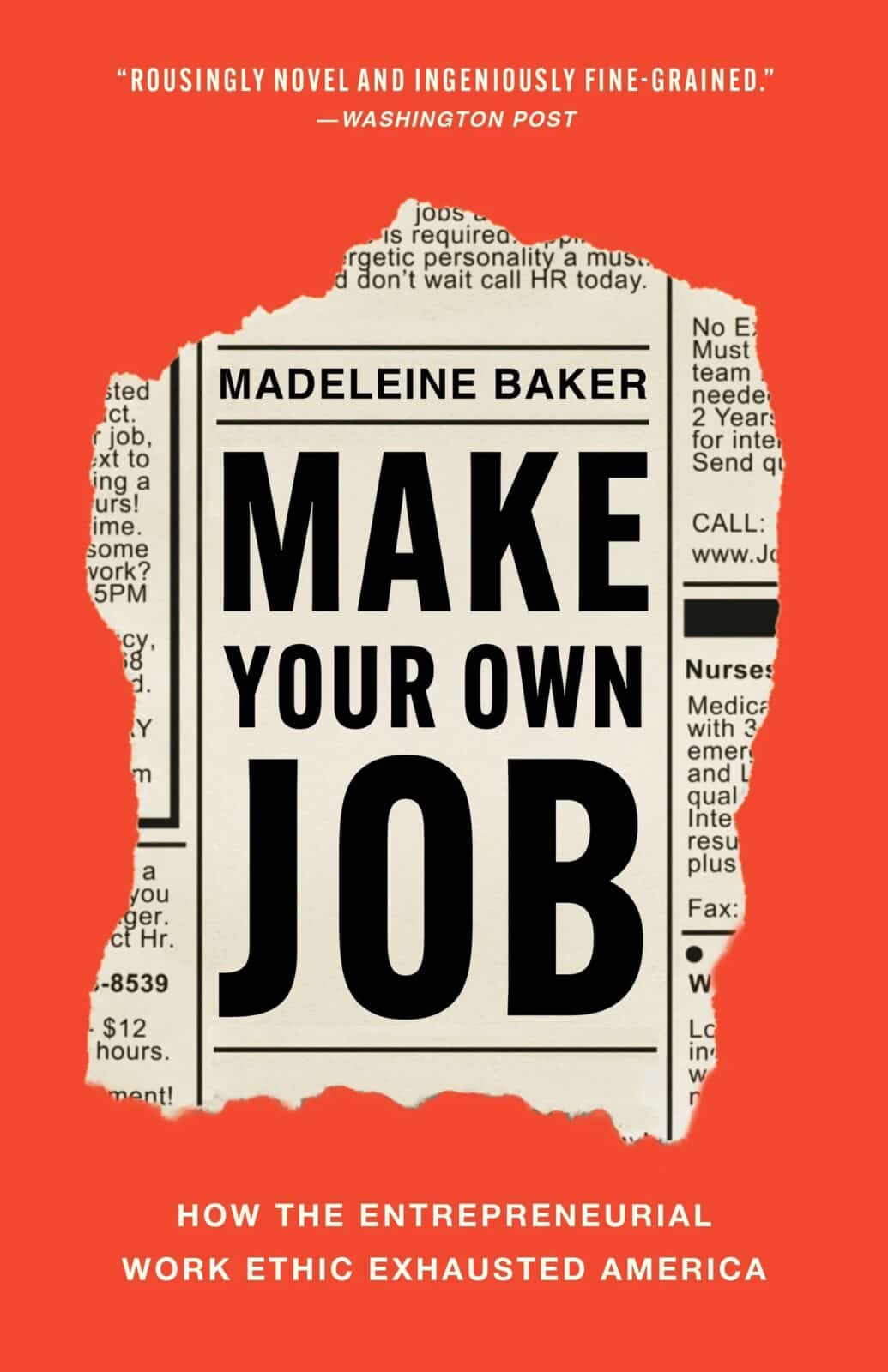
Make Your Own Job: How the Entrepreneurial Work Ethic Exhausted America
The Author(s)
Madeleine Baker
There has been a lot of talk about capitalism lately, a term people only tend to use when it’s giving us fits. One doesn’t have to be a Marxist to recognize that many of our most intractable problems—escalating authoritarianism, virulent nativism, deadly gun violence, rampant opioid addiction, rising political corruption, a boiling planet—are all to various degrees manifestations of an economic system that enriches the few while leaving the majority to fight over crumbs. This is life in the Second Gilded Age.
History offers little solace. During the First Gilded Age, the last time the world was this spellbound by capitalism, an unremitting quest for accumulation led to imperialist rivalry and ultimately two world wars that killed nearly one hundred million people. US history is not typically an antidote to despair, but in this case, it offers a sliver of psychological relief. Rather than succumb to fascism amid capitalism’s greatest crisis in the 1930s, Americans reformed their nation and staved off such barbarism. By softening capitalism’s harder edges, Franklin Roosevelt’s New Deal stabilized the system, thus saving it. The New Deal also ensured less talk about capitalism, for a while anyhow.
In our current perilous times, if we should collectively heed the historical lessons provided by the New Deal, we would support social democratic reforms of the sort championed by the likes of Bernie Sanders: universal healthcare and education, higher taxes for the rich, fierce support for the labor movement, housing subsidies, deep cuts to military spending. Although polls show that such policies are popular, neither political party in the United States prioritizes them. The Republican Party promises to rebuild the national economy to make it work for all Americans, but Donald Trump’s destructive economic policies veer between a chaotic protectionism, marked by his bizarre tariff program, and unabashed oligarchy, made apparent by yet more tax cuts for the rich and cartoonish levels of corruption. The Democratic Party, dominated by neoliberal gerontocrats, talks about economic fairness but, fearful of offending the party’s wealthy donors, mostly rejects social democratic policies. Kamala Harris’s big economic proposal during her 2024 campaign for president was the insipidly titled “Entrepreneurs and Innovators Policy Plan,” pitched to ease restrictions on small business start-ups.
By elevating the entrepreneur, the Harris campaign partook in a longstanding American tradition. Since the early twentieth century, as Madeleine Baker shows in her fantastic book, Make Your Own Job: How the Entrepreneurial Work Ethic Exhausted America, myriad politicians, economists, psychologists, management experts, and motivational speakers have prodded Americans to embrace their inner entrepreneur. By historicizing the clarion call for us to “make our own jobs,” another way of saying that everyone is individually responsible for their own economic survival even amidst ongoing structural transformations to the labor market, Baker deserves credit for telling a uniquely edifying story about the history of American capitalism. She also merits a pat on the back for doing us the important service of reading countless pages of platitudinous drivel written by some of the most annoying hucksters in American history, the peddlers of the entrepreneurial work ethic.
Make Your Own Job operates as an intellectual vaccine against smug tropes about a lazy generation of Americans, who would rather sit in cafés eating avocado toast than roll up their sleeves and get to work. When large chunks of the workforce refused to return to their shitty jobs after the Covid lockdowns had ended, in what has been termed the Great Resignation, elites whined about a nation of unprepared snowflakes. “American management has never been more convinced of its own enlightenment,” Baker writes with an appropriate level of snark. And yet despite their self-professed collective brainpower, American capitalists were caught off guard by epidemic levels of fatigue among the nation’s workers.[i] They seem inherently incapable of understanding that the entrepreneurial work ethic, which has become a universal expectation, is exhausting. In the First Gilded Age, workers were expected to be industrious. Now, in the Second Gilded Age, we’re not only expected to work hard, but we must also create our own jobs, excel at our jobs, even like our jobs! It’s enough to drive everyone mad.
Baker makes clear throughout her book that the entrepreneurial work ethic functions as ideological cover for the operations of an increasingly precarious capitalist labor market. We punish ourselves at work because our jobs are better than joblessness. Baker highlights this paradox by telling the old joke about diners who express two seemingly irreconcilable complaints to their waiter. “The food is terrible!” “Yes, and such small portions!”[ii]
Baker also makes clear that the entrepreneurial work ethic solves a problem created by capitalism, or at least, pushes it into the future. “The idea that creating work, for oneself and for others, was not just feasible for any given individual but an expression of a person’s unique talents and creative potential neatly resolved the contradiction between the imperative to work under capitalism and the scarcity of work created by its advanced corporate form.” Creating your own job will make you happier, since the job will be an extension of yourself, and thus presumably less shitty. Moreover, the compulsion to innovate will also rationalize an increasingly scarce labor market, where only the strong (or creative) survive. “If the entrepreneurial work ethic did not exist,” Baker writes, “it would have been necessary to invent it.”[iii]
The entrepreneurial work ethic subconsciously induces us to solve problems not of our own making. We as individuals can’t solve the problems of capitalism. The problems are structural. But we can be made to try, to think we have the power to do so, if only we make our own jobs. By putting the onus on the individual worker, as Baker writes in her characteristically terse manner, “Entrepreneurship is the way that capitalist society dreams of classlessness.”[iv]
In addition to serving as a political unmasking of the entrepreneurial work ethic, Make Your Own Job also works to correct historiographical misunderstandings. Prior to reading Baker’s book, I understood the entrepreneur as a social type that went back to the middle of the twentieth century, when Joseph Schumpeter hailed the entrepreneur as the plucky innovator threatened by the stalking horse of collectivism, whether in the form of the state or the corporation. But I wrongly assumed that the entrepreneurial work ethic—the values of the entrepreneur applied widely—only emerged alongside the neoliberal war against the working class. Baker shows that the seeds of the ethic go further back to the early twentieth century. This historiographical intervention is related to another argument Baker makes, that the labor market in the United States was never as stable for many workers as we might have imagined. Fordism, a period of capitalism driven by high wages and steady consumer demand, was not a universal condition. Precarity, how the working class experiences neoliberalism, was the state of things for an underestimated number of people even before the Second Gilded Age. And with precarity comes the entrepreneurial work ethic. When jobs don’t exist, you must make your own.
Baker traces the origins of the entrepreneurial work ethic to the New Thought movement of the early twentieth century. This starting point reveals another historiographical revision. Baker argues the recent intellectual history of capitalism over-emphasizes economists while under-emphasizing management experts and pop psychologists, two intellectual types that figure large in Make Your Own Job. The promise of New Thought (which was largely a pop psychology movement) was optimism about changing contexts; its social role was to help people adjust to shifting circumstances, especially new economic realities. As Elizabeth Jones Towne, a proto-self-help stylist and one of the pioneers of New Thought, wrote: “Get into line with a work you do love—something in which you can express yourself.”[v] Whereas historians of early-twentieth-century capitalism have emphasized the role of Taylorism, which indeed reshaped approaches to management, they have overlooked another side to the managerial revolution: the best managers, more than those capable of instilling discipline, were also those skilled in the art of inculcating enthusiasm. The best workers were enthusiastic about their work.
When German economists and social scientists, following the lead of management experts and pop psychologists, adopted the entrepreneur, the term secured a new, more powerful meaning. Baker writes that for German-language academics, the entrepreneur “became a Nietzschean conqueror, setting the world ablaze with his energy and virility.”[vi] Frank Knight, an early libertarian economist at the University of Chicago and an avid reader of the German social sciences, was one of the first Americans to contend that successful managers convinced workers to invest in their work—like entrepreneurs. By the 1930s, Harvard Business School fully embraced entrepreneurship as a concept worth studying, teaching, and promoting.
Harvard began pushing the entrepreneur onto American political culture at the same time the concept became popular among those who supported non-redistributive, non-New Deal solutions to the Great Depression. Chief among such proponents was Schumpeter, who theorized innovation was the key to preventing further crises of capitalism since innovation ensures the creation of new kinds of jobs as technology replaces older ones. Entrepreneurialism enables the job marker to stay one step ahead of automation. The success of the selling professions during the 1930s, most notably the rapid growth of the direct-sales company Avon, represented proof of concept. Those who sold Avon products were taught to believe that unemployment resulted from “mere weakness of will,” even at a time when as many as one-third of their fellow citizens had been rendered jobless by capitalism’s greatest crisis.[vii] During the Great Depression, “make your own job” meant not waiting around for the government to make a job for you.
The entrepreneurial work ethic appears to be a top-down propaganda project pushed upon workers by capitalists. But two qualifications need to be made. First, the propagandists tended to believe their own propaganda (which is often the case, as intellectual historians know well). Second, the entrepreneurial work ethic seemed genuinely promising to some workers, especially women and racial minorities, or those likelier to be locked out of the industrial jobs. For a black man struggling to obtain a high-wage factory job, the idea that he might create his own opportunities was enticing by default. This historical tendency was personified by the black nationalist Marcus Garvey, who innovated his own shipping and passenger company, the Black Star Line, to avoid white capitalism and liberate black people. That victims of hiring discrimination were sometimes entrepreneurial enthusiasts led to some unusual political alliances. Harlem spiritual leader Father Divine, who preached positive thinking to black New Yorkers, also supported the Communist Party (CPUSA) presidential ticket in 1932, and not only because the CPUSA vice-presidential candidate James Ford, a black man, was on the ticket. “For ordinary black Americans who faced no compulsion to ideological purity,” Baker writes, “it was possible to accept the entrepreneurial work ethic as a program for individual success in the short term while still looking to revolutionary socialism to bring collective liberation in the long term.”[viii] Baker’s book acts as a relentless historical critique of the entrepreneurial work ethic. But she is sympathetic to those who embraced the ethic as a potential way around discrimination, from black nationalists in the early twentieth century to Girl Bosses in the early twenty-first.
The entrepreneurial work ethic gained more momentum during the early Cold War. A host of positive thinkers, including Dale Carnegie, Norman Vincent Peale, Henry Luce, and Peter Drucker, personified a dynamic brand of capitalism they believed was best positioned to win the battle against the faceless totalitarians of Soviet communism. More than a Cold War project, the entrepreneurial work ethic also had a domestic purpose. Communists were not the only enemies of individualism. Closer to home, two personalities stalked the American political imagination: people with what David Riesman called “other-directed personalities” who conformed to an increasingly mass society; and people with what Theodore Adorno termed “authoritarian personalities” who obeyed reactionary traditions. By threatening individualism these homegrown bogeymen, much like foreign communists, threatened American democracy. In contrast, the entrepreneurial work ethic, plucky individualism’s platonic ideal, doubled as a democratic way of life, or simply, the American way. According to management theorist Peter Drucker, if the United States was going to set a democratic example for the world, leaders in all sectors of society, from corporations to government to universities, had to think like entrepreneurs.
During and after the 1960s, the entrepreneurial work ethic took on several new forms, some with unpredictable political valences. Out of the wellsprings of the New Left emerged “social entrepreneurship,” an expectation that saving the world required people to create their own non-profit jobs. This was the ecosystem of Ralph Nader, founder of several non-profit organizations such as the Public Interest Research Group and Public Citizen. Nader called his corps of activists “citizen entrepreneurs” (the media called them “Nader’s Raiders”), employees he expected would work around the clock, dedicate their lives to the cause, and not join a union.[ix]
A similar sensibility shaped another kind of countercultural entrepreneur, with vastly different consequences. As Baker writes: “The most ruthless entrepreneur to emerge from the milieu of the counterculture, and the most famous, was Steve Jobs.”[x] Jobs was more than a CEO; he was also Apple’s chief motivational speaker. This, as Baker’s book shows in detail, was nothing new. “All the cultic intensity of Jobsian management was just a particularly extreme version of the charismatic leadership prescribed by entrepreneurial management intellectuals since the early twentieth century.”[xi] The fact that Jobs cared nothing about the wellbeing of his workforce, especially the women who manufactured his products in China, and yet was still able to fashion himself an uber-enlightened, uber-innovative, uber-entrepreneurial leader, says a lot about what capitalism had become by the end of the twentieth century.
The entrepreneurial work ethic has chameleonic qualities. As artificial progressives like Jobs brought the entrepreneurial work ethic to Silicon Valley and other technology hubs, another group of American capitalists unapologetically adopted entrepreneurialism as an outgrowth of heartland conservatism. Building on Bethany Moreton’s book, To Serve God and Wal Mart: The Making of Christian Free Enterprise, Baker writes:
New Right executives and management intellectuals picked up on and amplified aspects of entrepreneurial ideology that midcentury liberals had tended to downplay: the analogy between the entrepreneurial firm and the patriarchal family; the entrepreneurial leader as a paternal authority; the entrepreneurial work ethic as an expression of faith in God and country; entrepreneurship as a way to make something of oneself, to ascend in status and to discharge one’s responsibilities to one’s family and community.[xii]
The prototypical right-wing champion of entrepreneurship was Ray Kroc, who turned McDonald’s into a fast-food chain familiar the world over. After Kroc and McDonald’s came Sam Walton and the superstore chain Wal Mart. Then came Richard DeVos and Jay Van Andel, founders of the multi-level marketing scheme Amway. These right-wing capitalists, following a long line of Gospel of Success preachers going back to the middle of the nineteenth century, accentuated the myth that anyone could work their way to success. They furthermore pitched their companies as engines of entrepreneurial meritocracy where employees could climb company ladders through grit and ingenuity. Such messaging, they assumed, helped them project themselves as men of the people, their companies as servants of America, and not just any America. They served a wholesome, traditional, Christian America.
The infamous Koch brothers further developed the conservative variant of the entrepreneurial work ethic. Koch Industries, founded by Fred Koch and later managed by his sons Charles and David (the brothers), was the benefactor of a conservative movement responsible for reshaping the regulatory system to the benefit of maleficent companies (a movement massively funded by the billionaire Koch brothers). Koch Industries required such legal support because it innovated a management system, Market-Based Management, or MBM, whereby the firm was called a “spontaneous order of employee entrepreneurs.”[xiii] Setting loose a free market of ideas within the company, Koch managers were incentivized by MBM to do whatever it took to increase profits, even breaking the law. MBM led to several criminal complaints and lawsuits due to preventable chemical spills that occurred in service to the bottom line. In the case of the Koch brothers, the entrepreneurial work ethic doubled as the sociopathic work ethic.
Renegade companies like Koch Industries were not alone in implementing management schemes that applied entrepreneurial techniques to their workforces. Blue chip companies also employed such “intrapreneurship,” an awful term for an unpleasant concept coined by Gifford and Elizabeth Pinchot in their manifesto-like 1978 paper, “Intra-Corporate Entrepreneurship.”[xiv] The trend of forcing employees to be entrepreneurs within large companies was accompanied by the management consulting boom, which was then followed by the shareholder revolution and the age of corporate raiders. Baker sums up these transformations nicely: “Corporate restructuring transformed American class structure. The line running through firms, dividing value-creating entrepreneurs from redundant or menial employees subject to layoffs or outsourcing, also ran through American society at large, dividing the haves from the have nots.”[xv] The entrepreneurial ethic had yet again rationalized the worst effects of capitalism.
By the 1990s, the ethic had penetrated American lives to a startling degree. In an era of greater labor market flexibility, a euphemism for labor market instability, it seemed everyone was compelled to make their own jobs, or die trying. The few who succeeded in this precarious endeavor were members of what came to be called the “creative class,” the title of management theorist Richard Florida’s 2002 book. Adding fuel to this rapidly burning fire, President Bill Clinton passed legislation in 1993 allowing CEOs to take shares of their companies as payment, on the grounds that higher compensation would generate more creativity. Of course, not everyone among the creative class basked in gluttonous greed. Beyond the CEOs were multitudes of increasingly burned out salaried employees who demonstrated that “not everyone wanted to live the life of a tortured artist while working in a corporate R&D department,” defying a century of New Thought wisdom, such as Norman Vincent Peale’s pearl: “The more you lose yourself in something bigger than yourself, the more energy you will have.”[xvi] The working class grew increasingly stratified between those without enough work and those who had more than they wanted.
In earlier moments of US history, unrelenting joblessness would have been a serious political problem for policymakers. In the New Economy of the twenty-first century, it was no longer necessary for politicians of either political party to concern themselves with unemployment numbers. It was certainly no longer required that Democrats cater to unions. Those Americans unable or unwilling to acquire the entrepreneurial work ethic were relegated to an uncreative underclass. Many of them were warehoused in prisons.
As Baker’s historical chronology arrives at our current time, it becomes apparent she has composed a history of the present. “Bad news for the economy,” she writes, “has always been good news for the entrepreneurial ethic, and the twenty-first century has been no exception.”[xvii] She continues: “In an era where precarity and underemployment seem more like a universal norm than the stubborn shadow of progress, it is possible once more with a full throat and an untroubled heart to enjoin people to make their own jobs.”[xviii] Make their own jobs have they ever! A gig economy full of Uber drivers and Doordash deliverers is the next logical step in our social devolution. “It is sometimes difficult to resist the feeling that the entrepreneurial work ethic had been demanding a technology like the digital platform all along, the necessary infrastructure for its full expression. It just took a hundred years to develop.”[xix]
Baker appropriately ends her fantastic book with a call to action. Should we make our own jobs, based on an entrepreneurial vision of a dystopian future where dogs continue to eat dogs? Or should we organize as workers, based on a collective vision of a hopeful future where humans act in solidarity? Baker concludes: “the entrepreneurial work ethic can accommodate both conservative visions of tradition and liberal visions of progress… [but] the one thing it can never make peace with is a politics of class conflict.”[xx] Amen, Comrade Baker.
[i] Madeleine Baker, Make Your Own Job: How the Entrepreneurial Work Ethic Exhausted America (Harvard University Press, 2025), 2.
[ii] Baker, Make Your Own Job, 253.
[iii] Baker, Make Your Own Job, 16.
[iv] Baker, Make Your Own Job, 9.
[v] Baker, Make Your Own Job, 33.
[vi] Baker, Make Your Own Job, 53.
[vii] Baker, Make Your Own Job, 74.
[viii] Baker, Make Your Own Job, 81.
[ix] Baker, Make Your Own Job, 142.
[x] Baker, Make Your Own Job, 145.
[xi] Baker, Make Your Own Job, 148.
[xii] Baker, Make Your Own Job, 163-164.
[xiii] Baker, Make Your Own Job, 183.
[xiv] Baker, Make Your Own Job, 191.
[xv] Baker, Make Your Own Job, 194.
[xvi] Baker, Make Your Own Job, 210.
[xvii] Baker, Make Your Own Job, 234.
[xviii] Baker, Make Your Own Job, 235.
[xix] Baker, Make Your Own Job, 241.
[xx] Baker, Make Your Own Job, 261.
About the Reviewer
Andrew Hartman, the first president of the Society for US Intellectual History, is the author of Karl Marx in America.
0