
The Book
Born in Blood: Violence and the Making of America
The Author(s)
Scott Gac
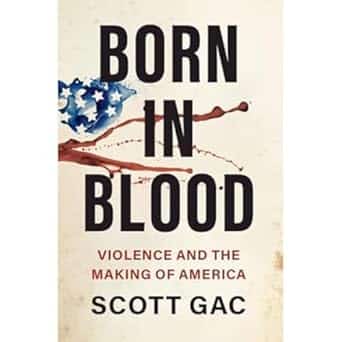
“The land was ours before we were the land’s,” spoke an aging Robert Frost as he recited his poem, “The Gift Outright” (published in 1943), at John F. Kennedy’s inauguration. The poem proceeds to acknowledge (perhaps grudgingly) that “The deed of gift was many deeds of war,” a line suited to the new President’s status as a decorated Naval veteran but also curiously appropriate to American culture writ large. Violence has long been a prominent feature of American society, as noted by observers across the political spectrum. Traditionalists proudly point to a martial tradition stemming from colonial militias and the revolutionary origins of American Independence. Revisionists focus their attention on the dark side of those deeds of war: hostile (and deadly) relations with North America’s Indigenous peoples and the violence underpinning the system of chattel slavery. Violence is, as Scott Gac argues in Born In Blood: Violence and the Making of America, “a national tradition” (3).
Violent armed struggle is so ubiquitous in American history, however, that it would seem difficult to pin down as a coherent phenomenon. Where and when should the historian begin, for starters? (Richard Slotkin’s history of this issue has now reached three volumes.) Gac chooses the Boston Massacre as his embarkation point, landing on this moment where British military force was deployed against restive subjects of the Crown, only to have the “redcoats” be defended by no less an American patriot than John Adams, who famously derided the Bostonians that confronted the regulars at Boston as a “mob” using by-now familiar racial and class epithets. “To White elites such as Adams,” Gac contends, “a large, diverse group of working-class protesters presented strife” (12). Upon this infamous episode Gac builds an analysis of a broad, longstanding phenomenon in which “American violence refers to a political formation of violent activity,” one “crafted in union with colonization and slavery” but also “an artifact of the American Revolution, a pathbreaking moment in the history of violent self-determination” (13). The violence Gac explores here (while acknowledging there are other, more justifiable forms) is committed by both the state and by individuals or communities sanctioned by the state, but this breadth of scope produces an uneasy balance at times in his argument. What forces tie together the heterogeneous institutions of the state and the so-called mob?
For Gac, the forces in question are global ones: liberal (and colonialist) capitalism and white supremacy. Beginning with a presumed union between capital and whiteness, he tracks violence from the outbreak of the Revolution into the era of Reconstruction and the Southern Redemption, with the victims ranging from the crowd in Boston in 1773 to Lee Walker, a Black man shot dead in Tennessee by a posse member as part of a lynch mob’s spurious manhunt. The book’s first three chapters range across the Founding era, from the Revolution itself to the conditions of life in the Continental Army to the 1790s. The three chapters in Gac’s second section touch briefly on the Jackson presidency before assessing the Antebellum era from the 1850s to the outbreak of the Civil War. The final four chapters chronicle violence from Reconstruction to the rise of modern industrialism capitalism at the end of the nineteenth century. (Here I single out Gac’s interest in the conditions of Black Union Army soldiers facing military discipline as particularly noteworthy–as is his consideration of the punishments facing white troops in the Revolution.) In the long transition between the North American colonies as far-flung outposts of the British Empire to a postbellum United States republic struggling to reconsolidate, Gac traces the transfer of power from imperial regulars to the lynch mob. The victims, too often, remain the same.
In an argument of such scope, omissions are inevitable. The displacement of Indigenous peoples may feel as if it receives short shrift. The Shays Rebellion, in which a private militia took on the task of deploying force that Congress could not fund, is discussed, but the suppression of the Whiskey Rebellion is not, for instance. The argument also feels a bit vulnerable to the inevitable accusations of presentism, possibly due to its also feeling somewhat under-theorized in terms of the relationship between individuals and society. (The early modern liberal tradition, beginning with Bacon and Hobbes and extending at least to the founders, is dispatched rather quickly in the introduction.) Gac aptly notes, for instance, that Washington authorized the corporal punishment of both enslaved persons at Mount Vernon and his enlisted troops, but whether Washington would have viewed the victims of such violence as equivalent would seem to be a matter open to debate. The historical record is, as far as I can tell, mum on the subject. History does rhyme, after all, but sometimes, like Robert Frost, we are deaf to its refrain.
About the Reviewer
Jason Shaffer is Professor of English at the United States Naval Academy and focuses on the literature of the Revolutionary and early republican period.
0