
Editor's Note
Enjoy previous posts of A Woman’s Work, an ongoing series about American women intellectuals, here.
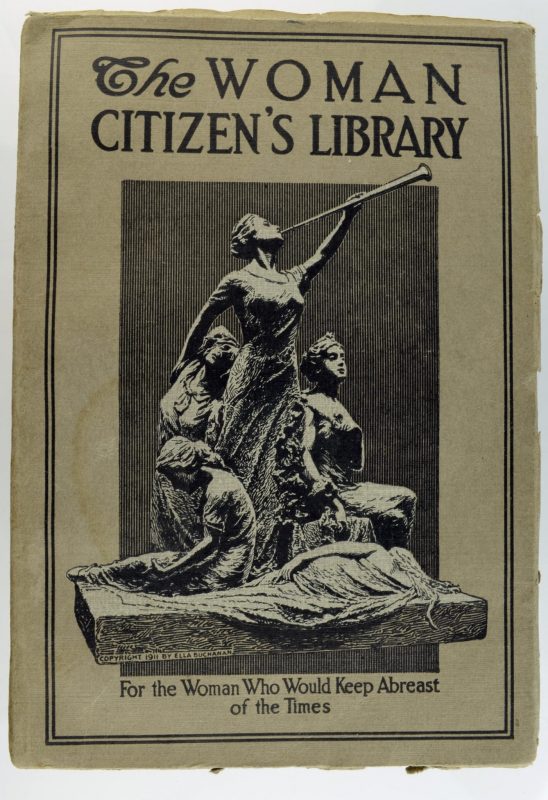 Read the news with a suffragist of 1913. Women’s rights advocates scanning the society page of the Atlanta Constitution on the morning of 4 June had a bevy of personas to peruse. There was the “Woman Shopper” gliding through a downy Eden of department stores: “Your presence, your influence and the wholesome atmosphere that pervades when you visit the store is an inspiration which tends to raise the standard of service.” There was an etiquette knot for the columnists to unsnarl, “The Summer Girl’s Problem,” posed by a bold headline asking, “Shall Mary Jane Let George Join Her When She Takes Trip to the Seashore?” From the top lefthand corner, civic pride led the page: “Among the City’s Best Assets Are Her Splendid Clubs.” Just below ran a key endorsement from one of those clubs, the Civics Society, and its business manager, Mrs. R. B. Parker. She recommended the free prospectus summarizing a new work, which numbered some 3,000 pages and would, as the Constitution promised, “furnish reliable, up-to-date information on the many political and social subjects now attracting such wide public attention.” As the luster of the “Summer Girl” and the “Woman Shopper” waned, influential clubs in Atlanta and across the country
welcomed readers to try something more revolutionary in nature: a new manual for protest and change known as The Woman Citizen’s Library.
What if suffrage leader Carrie Chapman Catt taught your women’s history class? Or Florence Kelley showed you how to inspect a factory? And then Margaret Robins helped organize your local union? By 1913, with women’s suffrage again in sight, at least one professor—Social Gospel star Shailer Mathews—tried to craft a portable guide by women and for women outlining how they might protest, vote, and change the world. To the mind of a public intellectual like Mathews, printing “The Woman Citizen’s Library” in a dozen illustrated volumes made sense for modern readers. His quasi-academic subtitle was ambitious: A Systematic Course of Reading in Preparation for the Larger Citizenship. Mathews’ Library, though, was far from quiet. It’s a compact archive of women citizens responding to social pressures and cultural concerns with big ideas. And, skimming past the familiar names of Catt, Kelley, and Robins, a roster of lesser-known reformers also comes to the anthology’s fore. Flip the volumes online to appreciate the well-curated collection’s early 20th-century vibes, especially the Victorian hangover (and hangups) that came with editing stale systems of morality. Here is a taste of the book’s insights.
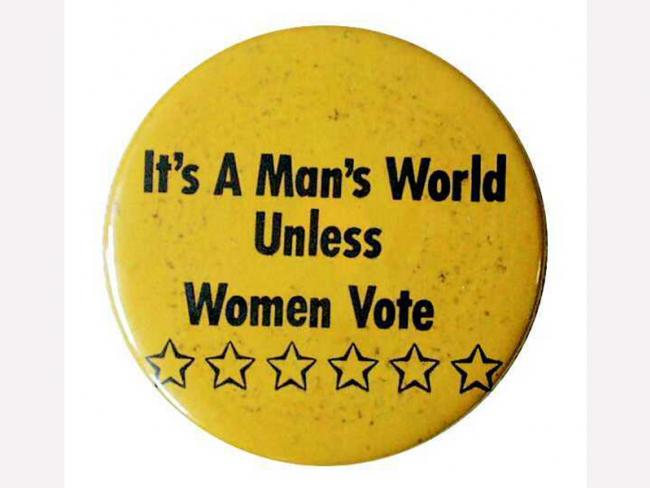
Political button, ca. 1918, promoting woman suffrage (Special Collections & Archives, Georgia State University Library)
First, Mathews made his case for the Library’s need from the texts of world history, by sketching a sort of “Age of Woman” that memorialized several centuries of suffering. Prehistoric woman, he asserted, was seen as the “burden-bearer”; medieval life relegated her to slavery and obscured her religious work; Enlightenment woman “begged that she might learn to read and write and was treated with scorn.” Glancing at the recent past of the 19th
century, Shailer Mathews mentioned women’s struggles in higher education, before rushing to his main theme of how they might meet the opportunity of the 20th century, namely, that women had been “offered a place in the council chambers of our states.” Extending the franchise, as Mathews and many peers thought, triggered the thorny issue of what “civics for women” looked like, in theory and practice.
By page two, Mathews laid out the question plainly: “THESE ARE THE PROBLEMS THAT ARE FACING WOMEN.” His well-worn list of “social evils” (labor regulation, clean homes, disease prevention) quickly took a more activist turn for women (how women should learn to track and audit public funds; “how to make their vote count in the fight for civic righteousness”; and why knowledge of state and national constitutions and governments was critical for an informed set of women voters). However well-intentioned, Mathews’ tone sometimes veered toward condescension in his opening remarks. The reader, nodding along in 2017, may experience whiplash from the 1913 voiceover suffusing passages like this one: “The State is as real as the people who compose it. The duties of citizenship are as definite as the duties of housekeeping. Only as these self-evident facts are fully appreciated will women be able to share in those many and splendid reforms which we can see must come in our social life. They ought, therefore, to know something of the great struggle through which Democracy has arisen…” To tell that very large and complicated saga of political science, Shailer Mathews invited 40-plus experts, all men and women oriented toward a new American Century of social reform, to guest-lecture in his Library.
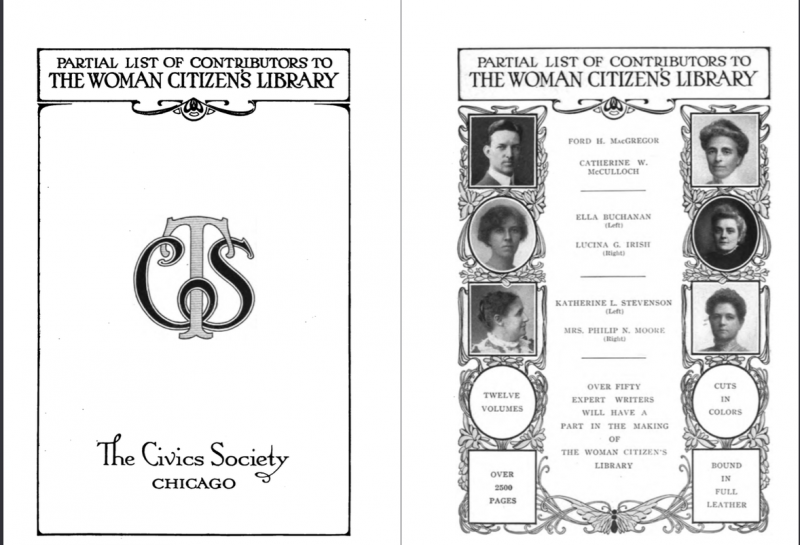 The Library’s goal was to educate and help women citizens as they segued into office. From their Library pulpit, Jane Addams and Anna E. Nicholes advised getting into city government as a form of “municipal houekeeping,” with the proviso that “there is no better manager than a good mother.” Imogen B. Oakley and L. L. Blankenburg, veterans of the national women’s club circuit, reimagined “The Ideal City,” a pest-free, gas-free utopia with clean food, compulsory education, and lush parks. (Mirroring larger trends Prohibition-ward, Number 9 on their list was non-negotiable: “The Saloon To Go”). Chicago native Louise DeKoven Bowen assessed juvenile crime, and Thomas J. Riley of Brooklyn reconsidered the function of “the almshouse and its inmates.” Frances Kellor investigated how New Yorkers did (and didn’t) go about “Safeguarding the Woman Immigrant.” Though city life was its primary focus, the Library supplied coverage of issues foreign and domestic. Lucia Ames Mead contributed a piece on “Peace and Arbitration,” refuting the idea that “government is based on force” and championing the newly created Carnegie Foundation for Peace. (USIH friends and colleagues: assign this work! use it in your public history exhibits!)
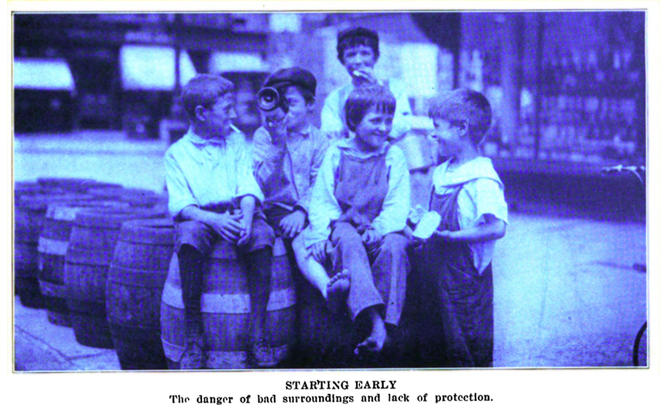 Occasional academic essays on hygiene, eugenics, and welfare provided interludes along with vivid photographs (right). How-to lists and illustrated guides with statistics filled the Library’s pages: how to present a balance sheet; where to walk on city streets to avoid disease; and when to save money by separating rubbish. Suggested discussion questions tested what women knew of city life, and demanded that they change it. The Library reads like a mixture of urban history, improvement manual, and social contract. Many of their questions resonate: “What methods may be used to develop a community or city sense?” and “What is the relation of women’s latest call to civic endeavor?” One more thing to note: not every reformer will sound familiar or famous—yet. There’s rich material here for intellectual historians to sift, and to identify more faces of a movement.
Women demonstrated “rapid thought, quick perception, and keen insight,” Mathews wrote, and so this syllabus merely added a sturdy instructional pedigree to buttress the arguments they made in—and for—American civic life. “It has never been a question of woman’s ability, but only of her opportunity,” Mathews wrote, toggling from historical justification to new political needs within a succint page or two. Next, he pledged to provide a Library, plus discussion “Questions for Review” for women’s clubs, a full-scale bibliography, and a “consulting service” that linked authors with their readers. Stepping back for a minute, it’s possible to identify the major operating components and Progressive goals of Shailer Mathews’ intellectual ministry: Make a popular serial work bridging the gulf between expert and protester, man and woman, scholar and citizen. Then, rely on local papers and women’s clubs to authenticate the cause and take it up. Finally, refuel organizing efforts via a permanent network that converts ideas into action.
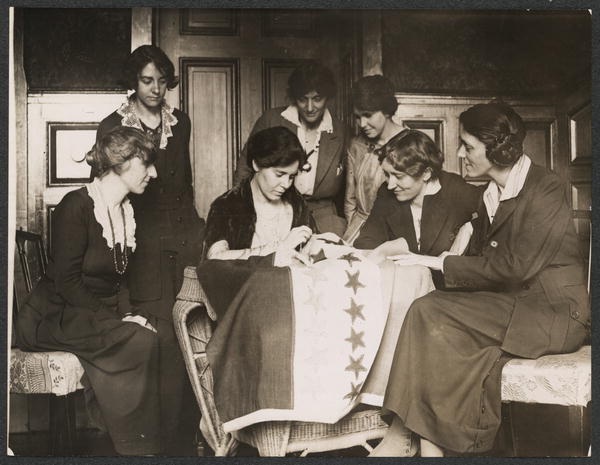
Alice Paul sews a star on the National Woman’s Party Ratification Flag (Library of Congress)
As the spring of 1914 inched into Mathews’ academic hometown of Chicago, where the 51-year-old Baptist was ensconced as dean of the University of Chicago’s Divinity School, favorable notices of the Library rolled in. Reviewers at the Oak Park, Ill., Oak Leaves, for example, savored the Library’s vast scope of subjects. “It is evident…that citizenship is to mean a larger, broader, higher thing to women than it has to the great mass of men,” the editors wrote on 21 March, “and we shall look to see the men themselves inspired to better civic ideals and activities than they have heretofore manifested. ‘The Woman Citizen’s Library’ may well be studied by both men and women voters.”
A print monument of the suffragists’ mission, the Library gifted Americans with a chance to rethink the ways and means of modern citizenship. Its critical success and high sales emanated mainly from the famous bylines that Mathews managed to crowdsource—and swiftly—for his voluminous cause. A century prior to social media efforts like #womenalsoknowhistory and #womenalsoknowstuff, Mathews set forth women (alongside men) as expert scholars worth consulting, and listening to. When local newspapers advertised the Library, they called attention to local women’s bylines in it, underlining that women’s voices are imperative sources of authority to hear. Further legitimating women’s scholarship, by 1917 many public librarians had invested in the Library, piling it in full on reference shelves from New York to Fort Wayne and beyond. For a generation, at least, the Library became a nexus of engagement for the women who marched, picketed, (finally) won suffrage, and said: What do we need to do next?
One Thought on this Post
S-USIH Comment Policy
We ask that those who participate in the discussions generated in the Comments section do so with the same decorum as they would in any other academic setting or context. Since the USIH bloggers write under our real names, we would prefer that our commenters also identify themselves by their real name. As our primary goal is to stimulate and engage in fruitful and productive discussion, ad hominem attacks (personal or professional), unnecessary insults, and/or mean-spiritedness have no place in the USIH Blog’s Comments section. Therefore, we reserve the right to remove any comments that contain any of the above and/or are not intended to further the discussion of the topic of the post. We welcome suggestions for corrections to any of our posts. As the official blog of the Society of US Intellectual History, we hope to foster a diverse community of scholars and readers who engage with one another in discussions of US intellectual history, broadly understood.
Sara, thank you so much for this post. What a rich primary source. It sounds like the whole Progressive Era — eugenics, temperance, waste disposal, suffrage and all — distilled into one compact library.
I see you’ve linked above to the Hathi trust library so that we can peruse all the volumes for ourselves — thank you! But a quick observation/question: this seems to be a source aimed squarely at white middle-class (or middle-class aspirational) women. How/where does race figure in to this “curriculum,” and how/where does solidarity with poor women or (gasp!) “fallen women” figure in? Or, based on your perusal, are these issues elided?
In any case, this looks like a great resource for some primary source selections for the survey. Thanks much!