
The Book
Rogue Elephant: How Republicans Went from the Party of Business to the Party of Chaos
The Author(s)
Paul Heideman
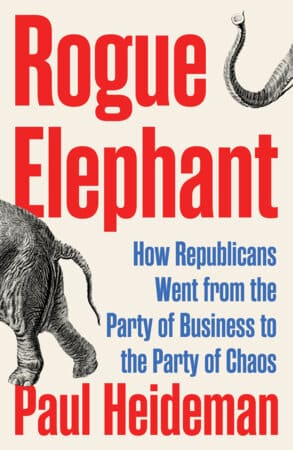
When a group of distinguished scholars, including historian Sean Wilentz, warned in 2025 in what became known as the Vanderbilt Report of the politicization of scholarship in the Humanities, they did not have in mind Heideman’s Rogue Elephant. The book is more polemic than scholarship per se. This is not to say that Heideman does not have some useful observation, something to say, but his argument and sources are filtered through a thick political lens to reach a predetermined conclusion.
The idea for the book grew out of an article Heideman was invited to write for Catalyst: A Journal of Theory and Strategy, whose “aim is to develop a theory and strategy with capitalism as its target — both in the North and in the Global South. It is an ambitious agenda, but this is a time for thinking big.” This article led to a book contract from Verso, a leftwing publishing house.
Rogue Elephant opens with a comparison of Donald Trump and Joseph McCarthy, although with different personalities and living at different times, as “Republican politicians whose conduct deeply divided their party” (Heideman 1). Heideman describes both as “demagogues.” Critical to each, Heideman argues, is that both McCarthy and Trump lost support of big business and financial contributors. Indicative of Trump’s loss of pro-business contributors, Hedeman finds, was the desertion of the Club for Growth and the Koch brothers, “who had been pushing the Republican Party to the right” Heideman 7). He seeks to explain why the Republican Party today under Trump finds itself “in conflict with American business leaders” (Heideman .9).
Heideman explores what he considers critical turning points in big businesses relationship with the Republican Party. He maintains that in the “disorganized world of American business” in the 1970s, American corporations organized the Business Roundtable to represent “business as a class” to the Republican Party. Heideman writes, “They got their way soon enough: Ronald Reagan’s election signaled the end of accommodation with forces of liberalism” (Heideman 12). Relations between big business and the Republican Party fell apart however and in the 90s, big business devoted themselves to the “most parochial and particularistic interests of their members in organization such as the Business Roundtable and the Chamber of Commerce. At the same time, Heideman maintains, insurgents in the Republican Party drew upon big business support to move the Republican Party further to the right in the 90s. Further division arose following George W. Bush’s presidency with the rise of the Tea Party. During the Obama presidency, big business saw the Republican Party as becoming “less and less reliable as stewards of their interests” (Heidman 14). Factional warfare within the party paved the way for Donald Trump’s takeover of the GOP. In this takeover, Trump, culminating in his 2024 victory drew “little support from Big Business” (Heideman 15). Trump’s takeover left the party, as Heideman terms it, in a state of chaos and the desertion of Big Business financial support.
In following chapters, Heideman details intraparty conflict within the GOP and fluctuating relations with financial donors. His narrative rests on the assumption that “Big Business” is a single entity, although he notes, “In the United States . . .business organizations have always been decentralized and limited in coverage. There has never been a single, peak-level business organization representing a strong plurality of American firms.” (Heideman 19-20). Heideman’s analysis fails to see Big Business divided into regional sectors, as well as often conflicting financial and economic interests. As a result, he fails to note or explore that Big Pharma was instrumental in the enactment of Obama’s Affordable Care Act in 2010, that drew wide opposition from other business interests. Nor does he mention that Wall Street security and investment firms contributed heavily to Obama in 2008 to the tune of $9.9 million compared to donations of $6.9 million to the John McCain campaign. McCain drew support in this sector primarily from Merrill Lynch. Heideman not only fails to mention Wall Street’s support of Obama but does not explore why Merrill Lynch supported McCain—all which suggests division even on Wall Street.
More importantly, Heideman does not seem aware that Democratic campaign finances have shifted from the party to targeted donations through an array of non-profit foundations such as Arabella (now Sunflower), New Venture, Sixteen Thirty, Hopewell, and North Fund. Deep pocket donors give directly to these non-profit foundations that disperse funds to various activist groups. Heideman might have looked at research from Capital Resources Center to understand this significant shift in campaign fundraising.
As a non-academic, Heideman deserves much credit for his extensive reading of secondary sources. Modern American scholars interested in practice of current American politics will find Rogue Elephant a rich source for recent literature. Those scholars interested in the ideas that drive party leaders, voters, and special interests will find Rogue Elephant of less value.
About the Reviewer
Donald T. Critchlow, faculty of History and Director of the Center for American Institutions, is the author of many books on American political history.
0