
The Book
Sex Isn’t Real: The Invention of an Incoherent Binary
The Author(s)
Beans Velocci
“Nature,” wrote the Marxist critic Raymond Williams, “is perhaps the most complex word in the language.” Though we intuitively understand appeals to nature when we hear them, Williams insisted, the many senses of the word are “variable and at times even opposed” to one another. Nature comes from a Latin root meaning “to be born,” so it has something to do with origins, with processes of becoming; but when it names “the essential quality or character of something,” nature slips from etiology to ontology (what something was is not necessarily what it is; things, as we say, change).[1] Nature’s ontological sense—its claim to describe what something really is—is slippery, too: while it is traditional, as Williams knows, to configure nature as the polar opposite of culture, historians and sociologists of science have been teaching us for some time now that we know nature only through culture.
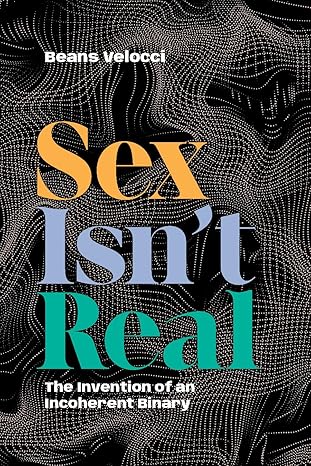
Beans Velocci begins Sex Isn’t Real: The Invention of an Incoherent Binary by quoting a closely related admission of lexical difficulty in the work of the twentieth-century endocrinologist Harry Benjamin. “There is hardly a word in the English language comparable to the word ‘sex’ in its vagueness,” wrote Benjamin in The Transsexual Phenomenon (1966): “The more sex is studied in its nature and implications, the more it loses an exact scientific meaning.”[2] As Velocci notes, this was a rare moment of nuanced lucidity from Benjamin, who is remembered today as the pioneer of trans medicine who also established its Heller-esque gatekeeping regime.[3] Benjamin’s non-definition positions “sex” as anything but an object of science: while scientific research, in theory, aims to sharpen our knowledge of nature through observation and experiment, sex seems to squirm and slip away the harder we look for it. That’s because, as Velocci argues throughout this important book, sex isn’t an object of scientific knowledge at all; it doesn’t—it can’t—cleanly differentiate certain bodies from others with the fine-edged blade of taxonomy. “Sex,” they write, “has very little to do with bodies. It’s about the categories and who controls them” (3). Sex isn’t finally about genitalia, genes, glands, gonads, or gametes. Sex, as the witticism goes, is about power.
Had Benjamin stuck to his anti-essentialist guns, perhaps Velocci would not need, sixty years later, to forcefully remind us that Sex Isn’t Real—or, more accurately, isn’t really what most people think it is (binary, stable, coherent, “biological,” a “scientific” “fact” of “nature”). But it is precisely Velocci’s contention that Benjamin, along with the theorists of sex who came before him, depended on and exploited sex’s fundamental conceptual incoherence: “the incoherent multiplicity of sex was a feature” of its construction from the advent of sexology in the mid-to-late nineteenth century, “not a bug” (3). Benjamin would insist on sex’s rigid, unchangeable binary when it suited his professional aims, even as he established himself as the United States’ highest authority on the medicines and operations by which people sought to change their sex. Sex’s construction as at once rigid and mutable, argues Velocci, enabled practitioners like Benjamin to determine which patients were deserving of hormones or surgeries based not on rational, scientific diagnostic criteria, but rather on clinicians’ personal biases and professional ambitions.
Sex Isn’t Real chronicles the century-long project of naturalizing the male-female sex binary, beginning from research into the often intriguingly nonbinary sexes of animals and insects in the zoology of the 1870s and 80s, and culminating in the fraught, phobic emergence of trans medicine in the 1950s–70s. It probably bears emphasizing that Velocci is not saying that no one had divided up the world—that of men or of beasts—into the categories of “male” and “female” before the nineteenth century. I take them to be arguing, rather, that as the study of sex became a form of experimental science—one grounded in modern scientific method, authorized by institutional “expertise,” implanted in universities and research labs, and funded by foundations and government bodies—there was a moment in which the scientific establishment could have developed a more capacious, less rigid model of human sex, simply by describing and theorizing the full complexity and instability of bodies it encountered. But “a desire for sex to naturalize social hierarchies” such as “race, scientific expertise, or gender,” Velocci argues, “superseded a need to address the anomalies that suffused sex research” (221). In this regard, a model of binary gender—though it wasn’t called that yet—preceded and determined the “scientific” model of binary sex.
Certain aspects of this argument might sound familiar. In 1993, the scare quotes looming in the title of Bodies That Matter: On the Discursive Limits of “Sex” anticipated Judith Butler’s argument that sex “is not a simple fact or static condition of a body, but a process whereby regulatory norms materialize ‘sex’ and achieve this materialization through a forcible reiteration of those norms” with a cunning nonchalance.[4] More recently, works of trans history such as C. Riley Snorton’s Black on Both Sides and Jules Gill-Peterson’s Histories of the Transgender Child have shown how scientific ideas about sex and its rigidity or plasticity took root in the fetid soil of racial hierarchy and eugenic pseudoscience.[5] Evidently, sex hasn’t exactly been “real” for quite a while.
Velocci builds upon this venerable body of work by reframing trans history within the contours of their academic discipline—science and technology studies—and by bringing to light new evidence of sex’s scientific incoherence from the sexological archive. For Velocci, sex is primarily a taxonomic system, a mode of classification, and taxonomies are inevitably blunt social constructions: “Classification systems are made,” they write, drawing upon foundational work in the sociology of science by Geoffrey Bowker and Susan Leigh Star: “made by people and institutions with their own interests and investments about who counts as what” (8). Those “interests and investments” are illuminated by Velocci’s impressive archival excavations, as well as by their canny readings of the routines and habits that repeatedly confirmed the sex binary even in the face of counterevidence.
In the book’s second chapter, for instance, which attends to the disturbing and quite literal proximity of sexological and eugenic research at two laboratories a stone’s throw from each other on Long Island, Velocci demonstrates that the eugenic lab’s system of notations for pedigree charts—in which women are represented by circles and men by squares—reinforced “the importance of sex in eugenic research”: “as a result of paperwork choices, the individual, in effect, became their sex, and sex a stand-in for the individual in eugenic analysis” (89). In the following chapter, on the ways in which the concept of womanhood was forcibly stabilized in gynecological medicine, Velocci unfolds a brilliant reading of how the material concerns of printing costs, paper weight, and visual legibility compelled one prominent gynecologist to represent sex as far simpler than his own medical practice suggested, as literally “black-and-white” (136–37). In other chapters, private papers and letters are mined for their deviations from scientists’ public statements about sex, and long-forgotten textbooks reveal the eugenic sympathies of major figures in sex research like Alfred Kinsey. Archival discoveries collude with a materialist and sociological historiography to produce Velocci’s most compelling and innovative claim: that binary sex is procedurally reinforced by scientific method, which—far from achieving its hypothetical aim of empirical objectivity—is itself the mechanism by which cultural bias and social hierarchy are transformed into “knowledge.”
The claim that binary sex erases trans and intersex people and embodiments through a kind of reductive procedural churn sits a little uncomfortably with Velocci’s framing argument that binary, cisnormative sex required (in an oft-repeated phrase) “a tremendous amount of work” (4, 6) to construct and maintain. Adapting an essay first published in the collection Feminism Against Cisness, Velocci opens Sex Isn’t Real with a rousing and necessary polemic against the naturalization of cisness as a category of being.[6] Cisness is just as artificial as transness, they argue: “Most people don’t just happen to fit the category they were assigned to. A whole apparatus churns along in the background, willfully ignored, to make it seem like they do” (10). Insofar as cisgender names a fictional alignment between two concepts that cannot be rigorously distinguished (one’s material sex and one’s social gender), this argument strikes me as irrefutable; but the lesson I took from Velocci’s accounts of sex researchers was not that they were consciously (or unconsciously) working hard to construct and maintain cisness—it was that they were sexist, racist, and lazy. It is easier to recapitulate social hierarchies than to challenge them; it is easier to sort people into categories than it is to account for their differences and complexities. What Velocci has so importantly shown, I think, is that the notion of “biological sex,” so often deployed as a rational, rigorous alternative to squishier concepts like “gender identity,” is itself the product of a lapse in scientific rigor.
Do I need to explain why the honest telling of this history is so urgent amid the authoritarian takeover of the United States? The bad science that Velocci describes is now official government policy; the president executively orders that binary sex is a “fundamental and incontrovertible reality.”[7] Many of us who work in education have been threatened with censure, censorship, and dismissal if we seek to tell the truth about what sex really is (or, worse yet, suggest that it isn’t anything at all).[8] As Butler has recently shown, moreover, this authoritarian retrenchment of binary sex in the name of “science,” or “reality,” or “nature,” is just one component of a global “phantasm” gripping right-wing activists, conservative governments, and the Catholic Church.[9] Phantasms are not science, and so, as Velocci sharply claims in their book’s epilogue, appeals to scientific rigor cannot answer the fascist erasure and oppression of the trans and intersex (and queer and non-white) persons policed by binary sex. Instead, they argue, we must begin by “deny[ing] the primacy of nature as justification to exist” (227). As Susan Stryker wrote in one of the founding documents of trans studies, “the Nature you bedevil me with is a lie”: for nature itself is both a product and a mechanism of power.[10]
[1] Raymond Williams, Keywords: A Vocabulary of Culture and Society, rev. ed. (Oxford University Press, 1985), 155.
[2] Quoted in Beans Velocci, Sex Isn’t Real: The Invention of an Incoherent Binary (Duke University Press, 2026), 1. Further quotations cited parenthetically in the text.
[3] Velocci describes the “circular path” on which trans patients found themselves at the behest of Benjamin and his colleagues: “They were transsexual because they wanted surgery, and they could not be trusted to make their own decisions about surgery because they were transexual” (200). In a recent video essay on such gatekeeping in the UK healthcare system, the YouTube host Abigail Thorn dons a World War II-era uniform embellished with a “Yossarian” nametag (Philosophy Tube, “I Emailed My Doctor 133 Times: The Crisis In the British Healthcare System,” posted November 11, 2022, YouTube, https://www.youtube.com/watch?v=v1eWIshUzr8).
[4] Judith Butler, Bodies That Matter: On the Discursive Limits of “Sex” (Routledge, 1993, repr. 2011), xii.
[5] C. Riley Snorton, Black on Both Sides: A Racial History of Trans Identity (University of Minnesota Press, 2017); Jules Gill-Peterson, Histories of the Transgender Child (University of Minnesota Press, 2018).
[6] Feminism Against Cisness, ed. Emma Heaney (Duke University Press, 2024).
[7] From an executive order quoted in Velocci, 228.
[8] It would not be difficult to cite many reports of these practices in the popular press and social media, but perhaps it will suffice to say that this happened to me.
[9] Judith Butler, Who’s Afraid of Gender? (Farrar, Straus and Giroux, 2024).
[10] Susan Stryker, “My Words to Victor Frankenstein Above the Village of Chamounix: Performing Transgender Rage,” GLQ 1, no. 3 (1993): 240.
About the Reviewer
Gabriel Bloomfield is an assistant professor of English at Smith College.
0