
The Book
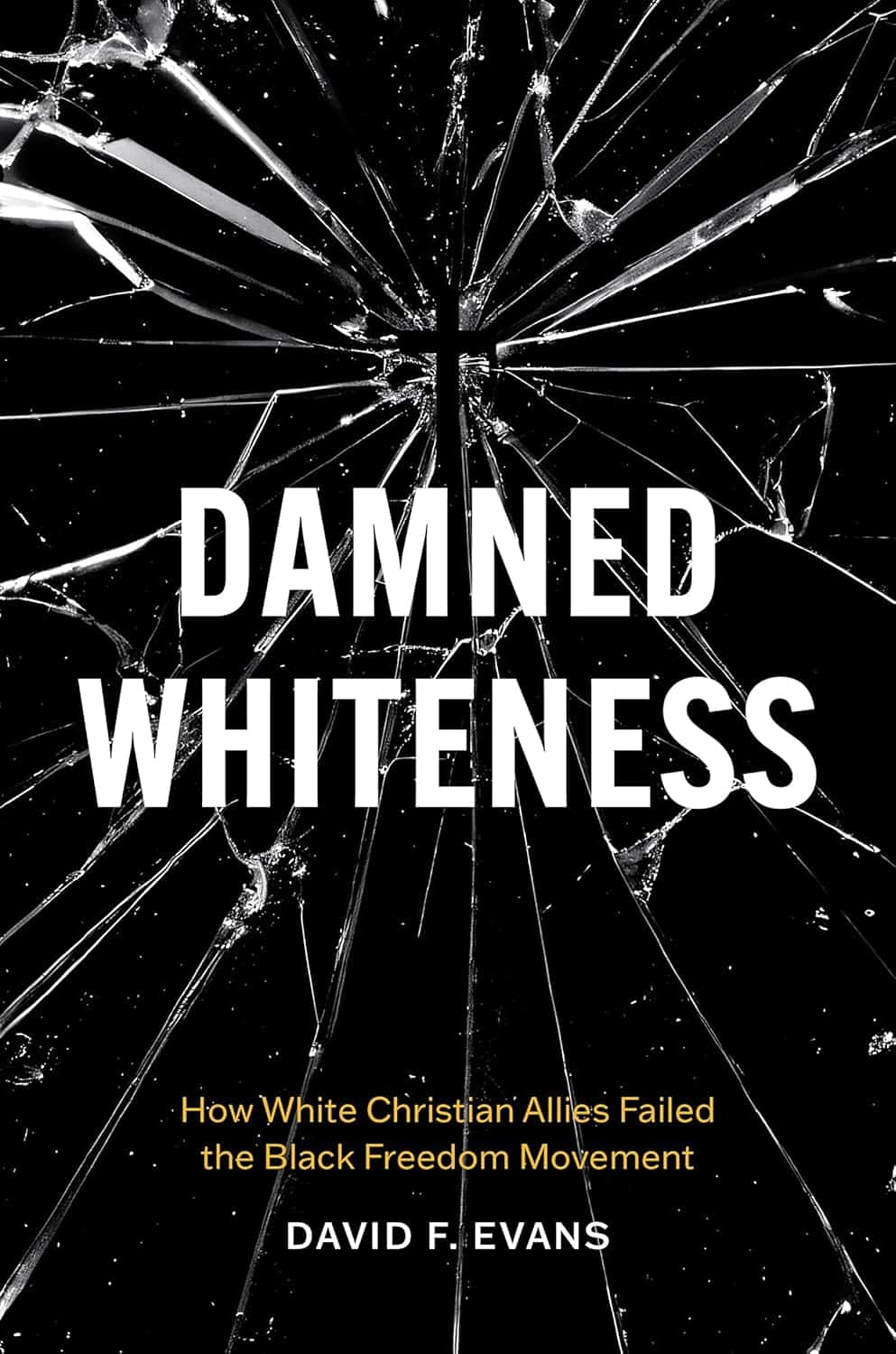
Damned Whiteness: How White Christian Allies Failed the Black Freedom Movement
The Author(s)
David F. Evans
At my previous institution, a seminary, I taught early and medieval church history. As my students sorted through ancient theologies, I encouraged them ask three questions of each text: What, according to this writer, is the essential human problem? How does Christ solve it? What manner of being must Christ be in order to accomplish this? For example, if the human problem is ignorance, Christ must be a wise teacher, but he need not be divine, while if the human problem is estrangement from God, Christ must be a divine mediator but could maybe only appear to be human. A mismatch between problem and solution would be theologically incoherent; it wouldn’t work.
David F. Evans, professor of history and intercultural studies at Eastern Mennonite Seminary, addresses a different set of mismatched problems and attempted solutions in Damned Whiteness: How White Christian Allies Failed the Black Freedom Movement (University of North Carolina Press, 2025). He argues that white Christians made poor allies for Black freedom fighters not because they were the wrong sort of people—i.e., not just because they were white—but because they misdiagnosed the problem, and they were more committed to the ideology of their diagnosis than to the practical matter of seeking real solutions. “If the problem was bondage,” Evans writes, “then freedom was the solution. However, if the problem was division and enmity, then friendship was the best hope.”[1] Starkly different diagnoses led to incompatible strategies for moving forward.
Black activists were willing to fight for freedom, while the white allies on whom Evans focuses—Dorothy Day, Clarence Jordan, and the lesser-known Ralph Templin—were staunch pacifists, connected to each other through the Fellowship of Reconciliation. Whiteness certainly made these allies less able to comprehend Black struggles, but for Evans, it was doctrinaire pacifism, combined with other rigid intellectual commitments, that ruined their potential effectiveness. Day prioritized charity and voluntary poverty, which caused involuntarily poor Black Americans to be more drawn to the Communist Party than to the Catholic Worker movement. Jordan foregrounded interracial friendship at the agrarian sanctuary of his Koinonia Farm, but his Black neighbors already knew how to farm and did not see friendship with white people as a sufficient end in and of itself.
Only Templin, who observed the predations of white empire as a missionary in India, was able to grasp that the travails of dark-skinned people would not be overcome with charitable handouts or communal meals. The dark-skinned people of the world and white people like Templin himself were all oppressed by what he called “damned whiteness,” akin to what other writers have called racial capitalism or colonialism. And if damned whiteness was the problem, nice whiteness was certainly not the solution, but perhaps Black Power could be. For Templin, Evans writes, “Black power offered liberation to all who faced the evils of white Western imperialism, domestic and abroad. Though Templin believed that his primary mission was to abolish white imperial and colonial rule for people on the other side of the color line, after years of research and activism he concluded that whiteness also bound white people in a prison of their own making. Having imprisoned everyone and freed no one, racial inequality was, in his opinion, the greatest threat to democracy in the West.”[2]
Analyzing these three white allies together enables Evans to avoid the complaint that he is holding them to an impossibly high standard, a complaint that scrutiny of heroes will inevitably raise. (Historian Karen Johnson, with whom Evans is in conversation at various points in this book, had a markedly different take on Clarence Jordan in her 2025 book Ordinary Heroes of Racial Justice, for example.)[3] Templin’s trajectory illustrates that a white ally of the mid-20th century could move beyond nice, peaceful, white-centered approaches to embrace a Black framing of social ills and Black leadership in addressing them. And while Templin did not have much opportunity to influence Day or Jordan directly, both of the failed white allies had other voices in their lives who could have taught them, if they were willing to listen. In chapter 3, Evans explains that Black physician Arthur G. Falls organized the Chicago Catholic Worker around education, activism, and economic uplift, but Day was unimpressed when she visited and thought he should focus instead on providing food and shelter for the destitute. In chapter 5, Evans contrasts Jordan’s folksy Cotton Patch Gospel with a contemporary text, Albert Cleage Jr.’s The Black Messiah, to show how white and Black hermeneutics produced divergent readings of Scripture in the late 1960s. Evans also shows how Day and Jordan sidelined Black expertise, undermined Black leaders, and tokenized Black people within their organizations. Imprisoned by whiteness, Day and Jordan were unable to further the cause of liberation.
Although this book and Johnson’s Ordinary Heroes differ in many respects, their goals are adjacent. Ordinary Heroes, published by the evangelical press InterVarsity and including questions for reflection and discussion, seeks to inspire its readers to keep pursuing the work of racial justice. Evans’s tack is less gauzy, more goading. He writes, “My desire is that Damned Whiteness will help focus the energies of Black freedom fighters on strategies for communal self-determination, especially when they find themselves struggling for liberation in predominantly white settings. In addition, I want this project to reveal to white allies the all-too-common impediments that allies bring to efforts that purpose to build effective antiracist coalitions.”[4] The nature of the human problem, for Evans as for Templin, is oppression, the solution is collective political action, and the beings who can accomplish this are historically informed freedom fighters, of all races. Nothing else, and nothing less, stands a chance.
[1] David F. Evans, Damned Whiteness: How White Christian Allies Failed the Black Freedom Movement (University of North Carolina, 2025), 14.
[2] Evans, 207.
[3] Karen J. Johnson, Ordinary Heroes of Racial Justice: A History of Christians in Action (InterVarsity Press, 2025).
[4] Evans, 241.
About the Reviewer
Elesha Coffman is professor of history at Baylor University.
0