
The Book
The Internal Colony: Race and the American Politics of Global Decolonization
The Author(s)
Sam Klug
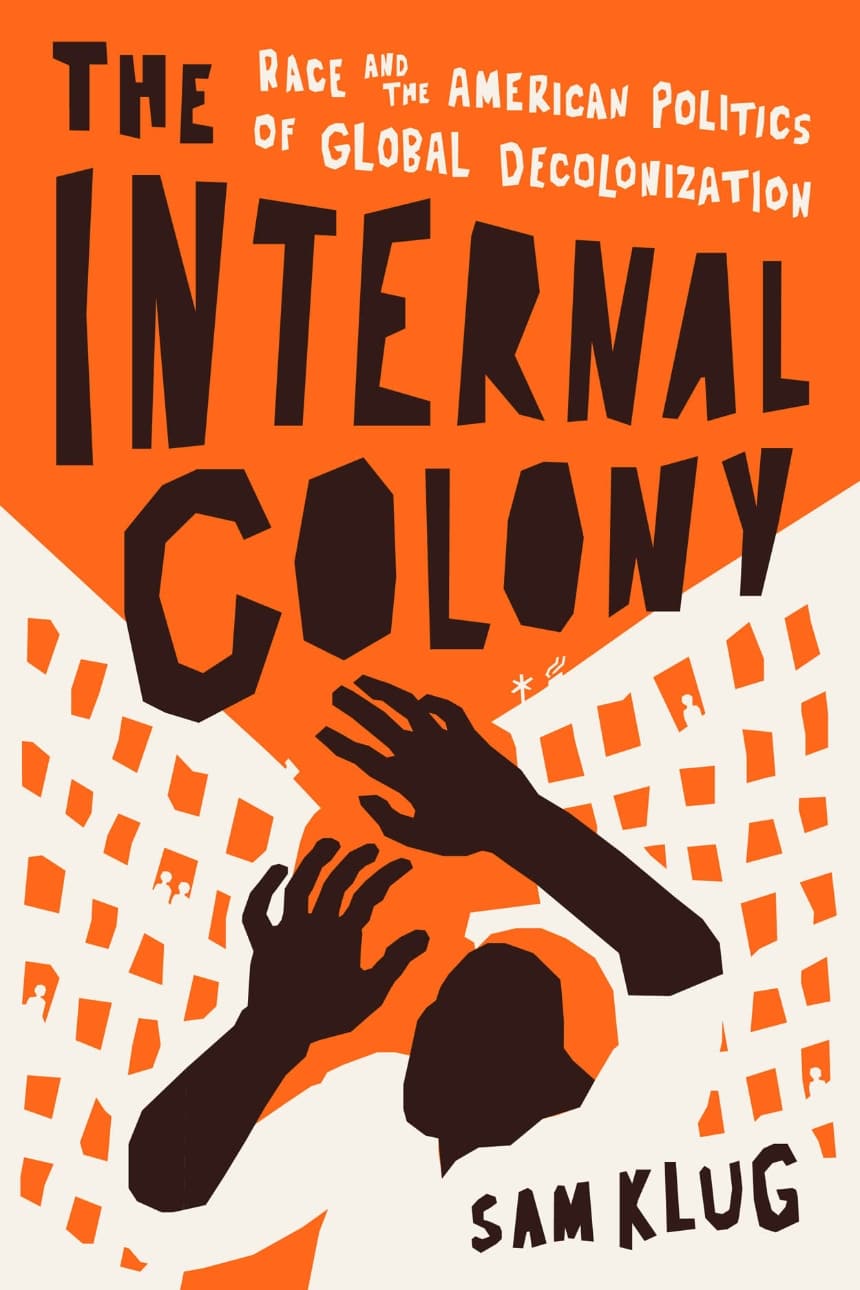
Sam Klug’s excellent new book The Internal Colony: Race and the American Politics of Global Decolonization tracks the history of an idea: that the position of Blacks in the United States is that of an internal colony. This idea emerged in the post World-War II era and continued to resonate with activists, thinkers and policymakers through the 1970s. These intellectuals shared with leaders of African anti-colonial movements an understanding colonialism as “as a problem of racialized economic exploitation, one that the mere granting of political sovereignty would not be enough to solve.” The struggle for decolonization, therefore, went far beyond the demand for legal enfranchisement and sovereignty to include an end to economic exploitation and the forms of domination that went along with it. Klug shows that it was this capacious understanding of colonialism and anti-colonial struggle that Black intellectuals invoked in order to make sense of the enduring harms of racial capitalism in America. His book asks: what new political space was opened through the metaphor of the internal colony?
Over the course of 10 chapters, moving more or less in chronological order, and traversing the diverse worlds of activism, organizing, policymaking and philanthropy in both the domestic and international sphere, Klug shows how Black intellectuals used the concept of the “internal colony” to reveal mechanisms of racial oppression; for example, by understanding urban ghettos as colonies, suffering not from mere neglect but rather from active exploitation, impoverishment and the extraction of wealth. Policymakers took on the internal colony analogy as well, using concepts like “indigenous leadership” as a mechanism of governance that could deliver social programs and smooth over potential dissent, drawing on much the same language colonial powers in Africa deployed to placate unrest and maintain social order. By placing themselves within the global story of colonialism and decolonization, the thinkers that appear in this book challenged the US self-perception as a global champion of freedom, a nation of formerly colonized people opposed to tyranny. They also cast doubt on the promise that African Americans were on a path towards equality through assimilation into American society, showing instead longer term mechanisms of subjugation resembling what Kwame Nkrumah called neocolonialism. Applied to the United States, the internal colony idea revealed new possibilities for solidarity on the global stage, while also raising the possibility that freedom could mean more than inclusion in an exploitative society.
Through a meticulously researched, fine-grained analysis of these ideas, Klug explodes at least two narrative conventions that still delimit historical inquiry: first, that the decolonization struggle occurred along a global north-south binary, in which global south made demands on the global north. Second, he contributes to a growing literature demonstrating that the Cold War was not the singular geopolitical struggle of the post-World War II years.
As an historian of Africa, I was most interested in Chapter 4, which considers Kwame Nkrumah’s ambitious and troubled Volta Dam Project from a pan-African perspective. Klug explores what was at stake for a range of African-American scholars, writers and social scientists in the success of failure of this project that sought African autonomy and self-determination through a project of industrial development. It seems to me that Klug’s framing puts Nkrumah’s pan-Africanism in a new light. I tend to think of 1957, the moment of Ghana’s independence celebrations, as Nkrumah’s key moment on a global stage in setting out an agenda for African liberation. But in giving equal attention to the Volta project as a decolonization project of global importance, Klug brings out the influence of the economic aspects of Nkrumah’s vision of decolonization, and the power of internal colony metaphor as a language of economic justice.
By the 1970s, the concept of the internal colony lost its political purchase and fell out of use, as movements for decolonization and a new international economic order faltered, and as postcolonial regimes faced economic crisis and, in some cases, slid into authoritarianism. A moment of possibility had been opened in the imagination closed.
This is the moment when I wanted more from Klug. Klug masterfully shows how these discussions of the “internal colony” moved and transformed through elite transnational intellectual networks in a finite window of time. But I found myself wondering what these ideas amounted to in the end. What did “the internal colony” allowed people to do? Were there demands or desires that made sense within the frame of decolonization that would not have made sense of gained traction otherwise? What did “the internal colony” metaphor make possible? What was lost when this political language went away?
Klug suggests that something vital was lost, writing in the final sentence of the book that we need to reclaim “a politics that envisions the domestic in light of the international.” What do we have to gain by doing so? What might we use the concept of the internal colony for? These days, colonialism as metaphor is back and seems to be everywhere. Is it doing good work? Taking seriously Tuck and Yang’s critique, that “decolonization is not a metaphor,”[1] and that using it as such can deflect attention from the very real, material struggles against historical dispossession, how does this history help us make sense of the potential for decolonization as a useful concept in struggles for social justice?
[1] Eve Tuck and K. Wanye Yang, “Decolonization is Not a Metaphor,” Decolonization: Indigeneity, Education and Society I (1), 2012, 1-140.
About the Reviewer
Emily Callaci an historian of modern Africa, global feminism and decolonization. Her first book, Street Archives and City Life: Popular Intellectuals in Postcolonial Tanzania, explores the creative lives of urban migrant youth to the city of Dar es Salaam during Tanzania’s socialist era, from 1967 through 1985. Drawing together a range of unconventional sources, or “street archives,” her book reveals a world of cultural innovation, literary production, and the elaboration of a distinctly urban subjectivity among migrants and refugees in Dar es Salaam. Her second book Wages for Housework: The Story of a Movement, an Idea, a Promise is an intellectual and social history of the global Wages for Housework movement from the 1970s. She is currently working on a third book, provisionally called Planning the African Family, which explores the intersection of decolonization and search for health and reproductive justice in sub-Saharan Africa in the 1960s-1980s. She serves as co-editor of the American Historical Review series History Unclassified.
0