
The Book
Business as Usual: How Sponsored Media Sold American Capitalism in the Twentieth Century
The Author(s)
Caroline Jack
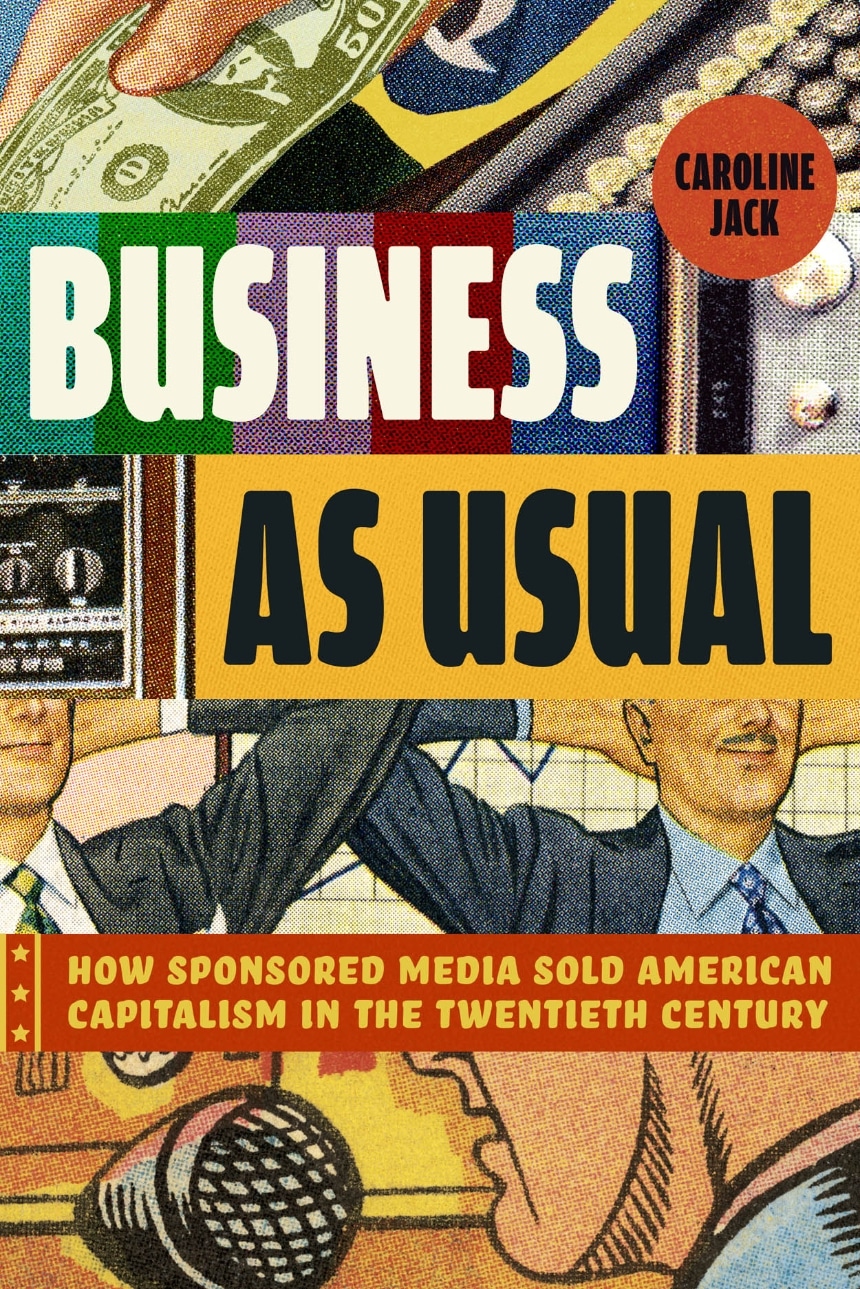
As disenchantment with capitalism grows, so too does recognition that capitalism has been sold to us as a bill of goods. Elites have long sought to convince Americans that capitalism is normal, natural, ineluctable, inevitable. As Caroline Jack shows in her book, Business as Usual: How Sponsored Media Sold American Capitalism in the Twentieth Century, a massive propaganda campaign on behalf of capitalism was advanced throughout the twentieth century by “sponsored media,” that is, media created and funded by American capitalists who sought to sell “America to Americans”—America here being another word for capitalism.[i]
Outside media studies, sponsored media is probably an unfamiliar term. According to Jack, sponsored media has largely evaded serious scholarly scrutiny due to its ephemerality. It’s not easy to research and write about something so difficult to pin down. Business as Usual represents Jack’s endeavor to fill this historiographical vacuum. That said, despite the novelty of its subject matter, Business as Usual nicely meshes with the rapidly growing historiography of American capitalism in the twentieth century. For instance, it complements Lawrence Glickman’s Free Enterprise: An American History, the best intellectual history of how big business successfully conflated capitalism and freedom in the American imagination. Jack does something similar by carefully detailing the media campaign to persuade Americans that capitalism is what endows us with the freedoms we enjoy. Freedom in general, however defined and including specific aspects such as freedom of expression, is dependent on the freedom of American capitalists to operate without pesky constraints like unions or government regulations. Or so the logic goes.[ii]
Capitalism’s pitchmen determined that the best way to sell capitalism to a skeptical audience was to teach economics. They believed that a proper understanding of economics was the equivalent of knowing the truth about capitalism’s greatness. To know it was to love it. Central to Jack’s argument, in this way, is the slippage between education and ideological mystification. “Supporters of sponsored economic education media,” she writes, “purported to be teaching an understanding of economics, but in fact conveyed a set of political assumptions and normative frames about what defined economic knowledge or thinking.” Although such maneuvering might seem like a clever propaganda program, Jack implies that capitalism’s salespeople fully believed in the product they were hawking, effectively demonstrating Slavoj Žižek’s pithy adage that the “ideological is a social reality whose very existence implies the non-knowledge of its participants to its essence.”[iii]
When it came to educating Americans about the beauty of capitalism, sponsored media’s tagline throughout the twentieth century was “selling America to Americans.” At first, selling America not only meant selling capitalism. It also entailed pushing anti-radicalism. This was especially the case during the Great Depression, when capitalists were put on the defensive by a militant labor movement, and by a reformist federal government led by the ostensible class traitor Franklin D. Roosevelt. That Roosevelt believed social democratic measures necessary to save capitalism from itself mattered not to those capitalists who would rather cut off their noses to spite their faces. Roosevelt’s New Deal exemplified Marx’s maxim that the modern state was a “committee for managing the affairs of the whole bourgeoisie,” even if such management angered the more self-destructive elements of the capitalist class.
Some such capitalists fared poorly against Roosevelt, such as those who started the American Liberty League, an association of businessmen formed in 1934 to oppose the New Deal, only to be leveraged by Roosevelt in the 1936 presidential election as an unpopular proxy for his Republican opponent. Other capitalists had more success, at least in the long run, partly because of their effective use of sponsored media. The National Association of Manufacturers (NAM) vehemently opposed the New Deal, which it characterized as a massive case of government overreach. But its opposition had more staying power due to its patient media campaign, which adopted the “selling America to Americans” trope. NAM capitalists fruitfully portrayed themselves as patriots rather than “economic royalists,” Roosevelt’s sardonic term for American Liberty League members.
The Second World War propelled sponsored media to new heights due to the advertising industry’s enlistment in the nation’s war effort. The Advertising Council, founded in 1942 with the express purpose of coordinating communications on behalf of a government at war—a true public service—did not limit its messaging to the global conflict. It also applied its patriotic megaphone to the task of selling capitalism, which it also pitched as a public service. “The advertising industry would use its newfound license to advance private enterprise ideology,” Jack writes, “but would frame these efforts as public service campaigns to increase knowledge of the US economic system.” Sponsored media, with the Advertising Council at the reigns, sold its pro-capitalist ideology as a patriotic public service. Teaching Americans economics would objectively help them.[iv]
Selling America to Americans came into focus just in time for a Cold War against an implacable anticapitalist foe. The general message coming out of the NAM and the Advertising Council was that economics education would inculcate Americans with anti-totalitarian habits of mind. Pupils would learn that capitalism was the bedrock of freedom, in stark contrast with communism, a system predicated on total government control. This message resonated with geopolitical imperatives, and with concerns closer to home. Pertaining to the latter, sponsored media sought to persuade Americans that a highly productive economy guaranteed a free society because it ensured freedom from want. Of course, the only way to ensure high productivity, according to capitalism’s pedagogues, was to place production in the hands of management, free from interference by government and labor unions.
The American population’s devotion to capitalism grew in the second half of the twentieth century. The degree to which sponsored media helped along such developments is difficult to prove. As Jack notes, the evidence of sponsored media’s success in convincing Americans that capitalism secured their freedom barely extends beyond ephemera. Yet, given the heavy investment economic elites made in it, the argument that sponsored media played a role in solidifying ideological hegemony is certainly plausible. If capitalists believed they were getting bang for their PR bucks, maybe they were right. Either way, sponsored media was never without its critics. In 1952, at the height of support for managerial capitalism, William Whyte, the sociologist best known for his later book, Organization Man, came out with a harsh takedown of sponsored media. Published by Simon and Schuster and mailed by Forbes magazine as a gift to its many subscribers, Is Anybody Listening: How and Why United States Business Fumbles When It Talks with Human Beings skewered sponsored media as a preposterous attempt by big business to sell itself rather than its actual products.
Even though sponsored media’s stated purpose was to educate Americans, the enterprise did not originally work to shape school curricula. This changed beginning in the 1950s, with the creation of the Joint Council on Economic Education (JCEE), which capitalists formed to train secondary teachers in economic education. The JCEE pitched its pedagogy as objective, even scientific, operating from longstanding assumptions about how such a seemingly rational approach would automatically gel with an anticommunist, pro-capitalist worldview. This method, rooted in what media historian Michael Curtin labels the “discourse of scientific anticommunism,” somewhat differed from previous lines of argument forwarded by capitalism’s salesman. Whereas the NAM advanced a rather simplistic if often effective propaganda message—capitalism is America, America is capitalism—the JCEE championed a less direct but to its mind more efficacious method of educating the American public on the obvious benefits of living in a capitalist society. Teenagers would take economics courses in high school with curriculum designed by the JCEE and other capitalist entities. In the process they would develop habits that would open their minds to the genius of capitalism. Jack contends the JCEE was more subtle than the NAM, and probably more effective. Subtle or not, the purpose of the JCEE, like that of the NAM, was to propagandize the American public.[v]
By the 1970s, as managerial capitalism transformed into neoliberal capitalism, sponsored media responded by hawking a different sort of product. Rather than selling Americans on the benefits of business organizations—the benefits of entrusting the nation’s economy to the CEO geniuses who stood atop corporations—sponsored media instead began preaching the specific merits of markets. With high rates of inflation corroding their spending power, Americans had to be taught that the market, not government, was the solution to their problem. More specifically, deregulation, another word for weakening government regulation of business, was newly sold as the objective, scientific, rational approach that all good Americans were supposed to support. By tracking the shifting tactics of sponsored media alongside political-economic shifts, Jack’s book doubles as both a history of American media and a history of American capitalism. We come to a fuller understanding of the economic and political transformations of American capitalism through an historical analysis of the twists and turns taken by its ideological champions.
It seems sponsored media was less effective by the 1970s. Or at least, it had less to work with in an age of stagflation, when many Americans fell out of love with capitalism. A beleaguered elite responded defensively, symbolized by the infamous Powell Memo. In 1971, Lewis Powell, who later was appointed to the Supreme Court, sounded the alarm with a memorandum titled, “Attack on American Free Enterprise System.” Many historians and activists have pointed to the Powell Memo as a signpost for neoliberalism. But Jack’s book demonstrates that Powell’s argument, about how knowledge of capitalism equates to support of it, was the raison d’être of sponsored media. Powell partook in a longstanding discourse, one going back to the early twentieth century, that assumed capitalism’s critics were merely ignorant. Anyone enlightened about its true essence would automatically support, even champion capitalism.
The hubris of capitalism’s pitchmen came to full fruition in the nation’s schools by the 1980s, when most states mandated economic education as a counterweight to the Marxist ignoramuses who supposedly controlled the curriculum. Ever since then, millions of young Americans have learned economics from teachers trained in the newfangled methods of capitalist propaganda, which included mastery of pedagogical tools like stock market simulation games. In the late 1980s, my own high school economics teacher, a proud libertarian, had us play the stock market game. He even graded us according to how well we played the game, or how lucky we got, imparting real-world lessons about capitalism on our impressionable minds. (I earned a C—lesson received! Note to reader: I soon after became a Marxist)
In 1979, consumer advocate Ralph Nader, sensing the dystopian future of education, commissioned a book, Hucksters in the Classroom: A Review of Industry Propaganda in Schools, that was intended to push back against the onslaught of capitalist propaganda. Not much came of Nader’s efforts on the precipice of the Reagan Revolution, which consolidated neoliberalism. Capitalism regained its spot atop the ideological pyramid of America. Business as Usual convincingly shows that such a victory could not have been achieved without capitalism vigorously sponsoring media—for better or worse! (I say worse.)
[i] Caroline Jack, Business as Usual: How Sponsored Media Sold American Capitalism in the Twentieth Century (The University of Chicago Press, 2024).
[ii] Lawrence Glickman, Free Enterprise: An American History (Yale University Press, 2019).
[iii] Jack, Business as Usual, 27. Slavoj Žižek, The Sublime Object of Ideology (Verso, 1989), 27.
[iv] Jack, Business as Usual, 76.
[v] Jack, Business as Usual, 112.
About the Reviewer
Andrew Hartman is the author of Karl Marx in America.
0