
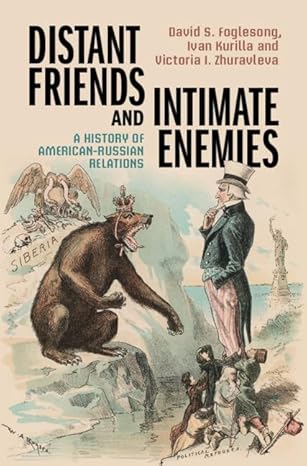
In Distant Friends and Intimate Enemies, David Foglesong, Ivan Kurilla, and Victoria Zhuravleva push back against the idea of an inherent historical conflict between the United States and Russia, pointing to the longer history of the relationship between these two countries. In an ambitious work that seamlessly integrates synthesis of secondary literature with a broad range of archival and media sources, they demonstrate that this context is essential to understanding American and Russian relations up to the present day. The authors suggest that from the end of the nineteenth century onward, Russia and the United States became “mutually constitutive Others,” reflecting a shared cultural fascination and antipathy.[1] Balancing Russian views on America with American views on Russia, the authors argue that “misperceptions, miscalculations, and mishandled crises,” rather than inherent conflicts between ideological or governmental systems, defined the relationship between the two countries.[2]
The authors, all experts in the history of Russian-American relations, divided the work based on their expertise, with Ivan Kurilla writing the chapters on the eighteenth through the mid-nineteenth centuries, Victoria Zhuravleva picking up with coverage of the second half of the nineteenth century through the Russian Revolutions of 1917, and Foglesong authoring the remaining chapters on the Soviet Union, the Cold War, and Russian-American relations to the present day. While the reader will note a change in style, all 18 chapters are quite readable and accessible to specialists and non-experts alike. One of the unifying aspects of the text is that all three authors engage with political cartoons and depictions of the US and Russia in their respective presses over the course of the nineteenth and twentieth centuries.
While the book speaks to the growing erosion of American-Russian relations in the late nineteenth and early twentieth centuries, the authors are careful to prevent either the Cold War or the current geopolitical context from coloring their assumptions about earlier periods. Ivan Kurilla’s first three and half chapters highlight that although Russia and the early United States had limited interaction in the early nineteenth century, by the time of the American Civil War the relationship was quite close, regardless of differences in governmental style. In Chapters 5 through 8, Zhuravleva builds on the development of the bilateral relationship and its impact on Russian-American relations through the revolutions of 1905 and 1917. She speaks to two emerging dynamics: Russian criticism of American hypocrisy and American disappointment at Russia’s failure to democratize. Zhuravleva suggests that the United States and Russia defined themselves in relation to the other by the turn of the twentieth century, to the increasing exclusion of Europe.
In the remaining ten chapters of the book, David Foglesong tackles the complexities, uncertainties, and frequent changes in American-Russian relations from 1917 to the present. Foglesong does an excellent job of balancing discussions of the actions and relationships among individual leaders with engagement with the realities of domestic politics. He pushes back against those who overstate the impacts of individual leaders in shaping Cold War and post-Cold War diplomatic relations, instead pointing to the clear importance of “citizen diplomacy” and the media.[3] Chapters 17 and 18 do an admirable job of discussing the 1990s and the early twenty-first century, bridging the fall of the Soviet Union and reminding the reader that recent Russian-American relations deserve the same nuanced analysis given to the Cold War. Foglesong carefully avoids focusing blame on any one decision or individual group for the erosion of American-Russian relations in the 1990s, reminding readers that “the degeneration of relations was driven to a great extent by American triumphalist mythology about how the Cold War ended, unrealistically high Russian expectations of American aid and respect, and domestic political dynamics in each country.”[4]
Cambridge University Press advertises this book as a history of Russian-American relations from the eighteenth century to the present, but eighteenth and nineteenth century historians may find the work less relevant. The first chapter, on the seventeenth and eighteenth century, is incredibly readable, but it covers two hundred years in nineteen pages. The subsequent four chapters on the nineteenth century provide a snapshot of Russian-American relations, but the bulk of the book centers on the late nineteenth century to the present. For historians of American, Russian, and Soviet history in the twentieth century, these earlier chapters provide essential context and an invaluable corrective to unfounded assumptions about the earlier history of Russian-American relations. Despite this minor quibble on advertising, the work as a whole provides a balanced engagement with the long history of Russian-American relations, providing anyone interested in understanding the complexities of the current moment with an accessible, comprehensive, and entertaining overview.
[1] David S. Foglesong et al., Distant Friends and Intimate Enemies: A History of American-Russian Relations (Cambridge University Press, 2025), 118.
[2] Foglesong et al., Distant Friends and Intimate Enemies, 341.
[3] Foglesong et al., Distant Friends and Intimate Enemies, 343.
[4] Foglesong et al., Distant Friends and Intimate Enemies, 372.
About the Reviewer
Virginia Olmsted McGraw is an Assistant Professor of Soviet History at the United States Naval Academy in Annapolis, MD. Her research focuses on the cultural Cold War, clothing design and production, and the Soviet state and society after World War II. She is currently completing a monograph on Soviet fashion design and international competition during the Cold War. The views expressed in this book review are those of the author and do not reflect the official policy or position of the U.S. Naval Academy, the Department of the Navy, the Department of War, or the U.S. Government.
0