
The Book
Baldwin: A Love Story
The Author(s)
Nicholas Boggs
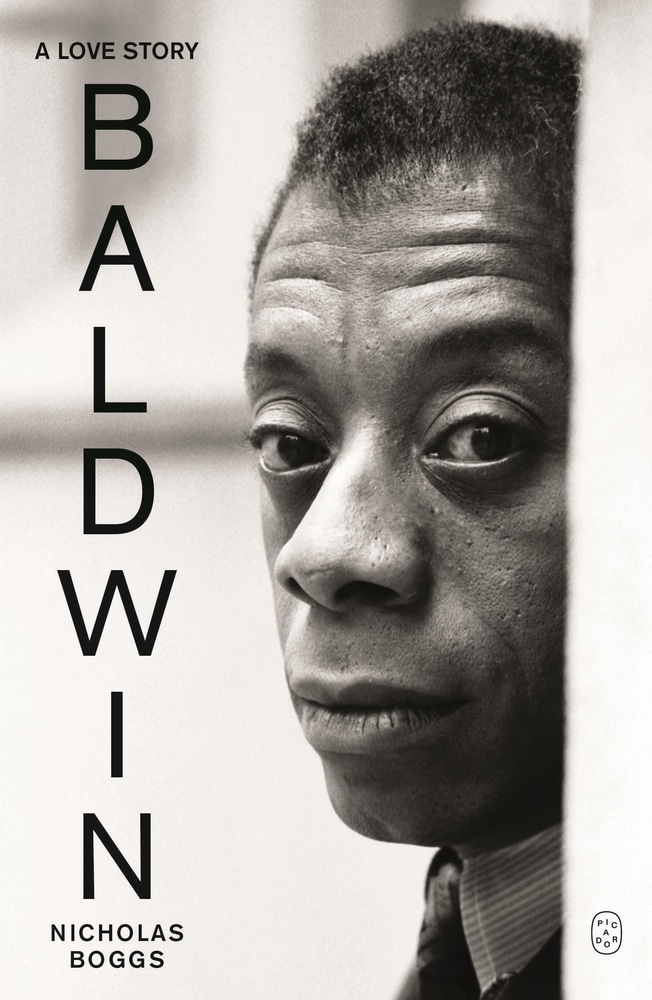
After years of renewed scholarly and popular interest in the author and orator James Baldwin (1924-1987) but no new major biography, along comes Nicholas Boggs with this doorstopper, a monument to his energetic research and faithful reading in the voluminous sources now available on, by, and about Baldwin. Boggs had re-discovered Baldwin’s out-of-print children’s book, Little Man, Little Man (1976), as an undergraduate at Yale, bringing out a 2018 edition thanks to collaboration with the book’s illustrator, Yoran Cazac (1938-2005)—largely unknown to Baldwin scholars until Boggs found him, alive—and the blessing of the Baldwin estate, signified in the foreword to the reissue, written by Baldwin’s nephew Tejan Karefa-Smart, and its afterword, written by his niece Aisha Karefa-Smart. Boggs earned a doctorate in literature at Columbia, intensifying and deepening his focus on Baldwin and ultimately absorbing all of Baldwin’s publications, his archives at the Schomburg and the Beineke, interviews, recordings, footage, memoirs, and much of the work on Baldwin done by others, especially his companion and early biographer David Leeming and contemporary Baldwin scholars Ed Pavli? and Magdalena Zaborowska. Boggs synthesized this dazzling span of material to write the most comprehensive account of Baldwin’s life to date.[1]
Baldwin: A Love Story is organized around the four men Boggs designates as Baldwin’s principal loves: Beauford Delaney (1901-1979), the gay Black American artist who helped the young Baldwin see beauty in an oil-soiled puddle and in himself as well, to whose well-being Baldwin was devoted for the rest of Delaney’s life; Lucien Happersberger (1932-2010), the Swiss artist and hedonist who was Baldwin’s touchstone sexual-romantic love, who never truly chose him but was with him at the end; Engir Cezzan (1935-2017), a Turkish actor who provided Baldwin the most nourishing hospitality he ever knew thanks to his wife’s cooking and the cosmopolitan artists of Istanbul, and; Cazac, who told Boggs “Jimmy was one of the great loves of my life” in the book’s most stunning reveal (510). Boggs also carefully weaves in many other figures—most importantly Baldwin’s white teacher Orilla “Bill” Miller (1910-1991), who took Baldwin to theatres downtown for years, and Mary Painter (1920-1991), the Minnesota-born economist and diplomat who supported Baldwin financially and personally on both sides of the Atlantic for at least a quarter century—but his relentless focus is on Baldwin’s intimate relationships with men. The most important contribution this biography makes to Baldwin studies and to American intellectual history is the detailed representation of Baldwin’s experience of and ideas about gender and sexuality, which Boggs finds intertwined and shifting over Baldwin’s too-short but very busy life. Baldwin craved devoted intimate companionship with a man, but his entire adult life he chased men who were primarily attracted to women, Boggs shows, and he accepted his lovers’ inconstancy, infidelity, and financial dependency on him as the price of his ticket to love decade after decade. Boggs disrupts the binaries of sex and gender because Baldwin did, telling Happersberger in 1955 that “two men cannot be married unless one of them is willing to cease being a man” (152-153), exploring androgyny, performing a certain mid-twentieth century American masculinity in his young adulthood and allowing himself to wear scarves and jewelry with panache after years spent in Istanbul, where men holding hands with one another was normal and so were accessories for men. Boggs is overzealous, at times, in seeking to establish Baldwin’s same-sex attractions and experiences—failing to convince, on the weight of his own evidence, in critical cases—but his frank, open, vivid engagement with Baldwin on these terms is vital not only for what it reveals about Baldwin but also for what it shows true about homosociality in the transatlantic intellectual world of the second half of the twentieth century: men could express love to one another openly, ardently, whether that love was carnal or not, in the right settings. Heteronormativity certainly prevailed, yet it is also true that homophobia was not powerful enough to prevent same-sex connection, which is dramatically represented in Baldwin’s works and in this biography.
Literary biography has a long lineage in American intellectual history, going back to such luminaries as F.O. Matthiessen (1902-1950), a forefather of this work partly because of his own long, widely acknowledged intimate relationship with a male partner. Both fields have come a long way since then, with the discrete studies of race, gender, and sexuality developing during the twilight of Baldwin’s career, all of which come together in this biography because Baldwin crossed so many boundaries himself. Indeed, Baldwin was arguably the most important American thinker of the twentieth century because of how he critically engaged with all the major modern categories—race, class, gender, ethnicity, sexuality, religion, nationhood—when no one else stood at that nexus, and because of how he reached across the Atlantic to consider colonialism, capitalism, and their consequences. Boggs is so intent on Baldwin’s sexuality that he could not, even in all these pages, critically evaluate Baldwin’s engagement with most of these topics, but his narrative choices help illuminate the boundary between literary studies, of which this biography is exemplary, and intellectual history, which remains the one field in the academy that includes all other fields of study. Although this biography takes place in the past, it is not a history. Boggs narrates rather than argues, frequently imagining what Baldwin was thinking or remembering in a ruminative style that reminds the reader of passages that have come before, the most important of which describes, better than anyone has ever done before, the time Baldwin spent with Happersberger in the Swiss mountains while he was writing his debut novel Go Tell It on the Mountain (1953). Boggs interjects psychological conjectures, shortchanges Baldwin’s non-fiction, and treats Baldwin’s fiction and poetry as straightforward mirrors of his personal reality. Eldridge Cleaver’s attack on Baldwin matters here because it was blatantly homophobic; Albert Murray’s critique goes unmentioned because it is beyond the scope of this narrative. The citation style is geared toward a non-scholarly audience, leaving many claims unsourced, and a gossipy tale about Baldwin’s becoming unwelcome at the MacDowell colony halts where its last entry in the index does (162), while Baldwin returns to MacDowell repeatedly as the course of the book and his life continues (241-248, 277-279, 335). In Book IV, the final section centered on Cezzan, Boggs shifts to the first-person and enters the text, distinctively subjective rather than objective. Most importantly, this biography is made of text, not context. For historians, Baldwin’s ideas about masculinity are illuminated not only by what he said or may have felt, but also by scholarship on its history, most recently Ronnie A. Grinberg’s excellent Write Like a Man: Jewish Masculinity and the New York Jewish Intellectuals (2024), a central milieu for mid-century Baldwin. Most tellingly, for Boggs, when Baldwin “said he ‘had no antecedents,’ he wasn’t being self-aggrandizing; this was the truth” (597). For historians, no one comes from nowhere.
[1] Douglas Field, All Those Strangers: The Art and Lives of James Baldwin (New York: Oxford University Press, 2015), Nicholas Buccola, The Fire is Upon Us: James Baldwin, William F. Buckley, Jr., and the Debate About Race in America (Princeton: Princeton University Press, 2019), and Anna Malaika Tubbs, The Three Mothers: How the Mothers of Martin Luther King, Jr., Malcolm X, and James Baldwin Shaped a Nation (New York: Flatiron Books, 2021) are notable omissions. For an excellent overview of Baldwin biography, see William Henry Pruitt III, “From Furious Passage (1966) to Living in Fire (2019): A Review of Biographies About Baldwin,” James Baldwin Review 9.1 (2023): <https://doi.org/10.7227/JBR.9.10>.
About the Reviewer
Amy Kittelstrom (PhD History, Boston University 2004) is a Professor of History at
Sonoma State University who specializes in American thought and culture. She is the
author of The Religion of Democracy (Penguin, 2015), which traces the development of
liberal intellectual culture from its Christian roots in the eighteenth-century concept of
moral agency to post-Christian pluralism by the turn of the twentieth century. She has
written critical essays on the state of the field of American intellectual history, including
“The Life of the Mind in the Early Republic,” Journal of the Early Republic (2023) and
“The American Mind is Dead, Long Live the American Mind,” Modern Intellectual History
(2021). Her current book project is an intellectual history of James Baldwin (1924-1987)
that excavates the reading that shaped him to reconstruct the liberatory intellectual
tradition he exemplified; this research produced “James Weldon Johnson, Langston
Hughes, and the Ever-Deferred Dream,” Black Perspectives (2023). Since 2023, she
has been the lead investigator of groundbreaking research on the history of slavery in
Sonoma County, California, in partnership with the Santa Rosa-Sonoma County
NAACP.
0